




Our Courses
All Courses

Course Library View the full range of courses

Start with these learner favorites

Complete Teaching Assistant Diploma (TA, SEN, Autism, ADHD & Dyslexia)
11 hrs, 28 mins 3389
Microsoft Excel Complete Course – Beginner Intermediate & Advanced
11 hrs, 6 mins 1953
British Sign language (BSL) Level 1 Online Course
4 hrs, 43 mins 1738

Effective Communication in Nursing: The Key to Excellence

Josie Mckenlay
Published By Josie Mckenlay
Effective Communication in Nursing: The Key to Excellence
7 minutes read

Article Summary

Learn why effective communication in nursing improves patient care, teamwork, safety, and professional success in every healthcare setting.

Effective communication in nursing is a cornerstone of quality patient care. It fosters trust, understanding, and collaboration, leading to improved outcomes for patients. Nurses who have strong communication skills in nursing can bridge the gap between patients and healthcare providers.

In this short blog, you will learn about effective communication in nursing from A to Z. 

Why is effective communication in nursing so important?

Communication is the only means to ensure the best service & care to the patients. Let’s see the importance of communication in nursing in the following…

Patient Safety: Clear and concise communication in nursing prevents misunderstandings, medication errors, and delays in treatment. It ensures that everyone involved in a patient’s care has the information they need to make informed decisions.

Patient Satisfaction: When patients feel heard, understood, and involved in their care, they are more likely to be satisfied with their experience. Effective communication in nursing helps build trust and rapport between nurses and patients.

Team Collaboration: Nursing is a team effort. Solid communication skills in nursing among nurses, doctors, therapists, and other healthcare professionals ensure that everyone is working towards the same goals and that care is coordinated seamlessly. 

Better communication skills will give you an edge in maintaining flawless team collaboration. 

Improved Outcomes: Studies have shown that good communication in nursing can lead to better patient outcomes, including reduced length of stay, improved adherence to treatment plans, and higher patient satisfaction. 

When patients receive clear instructions and support, they are more likely to follow their treatment plans and recover quickly. So there is no alternative for you as an aspiring nurse or an active nurse to build solid communication skills.

The 6 C’s of Effective Communication in Nursing
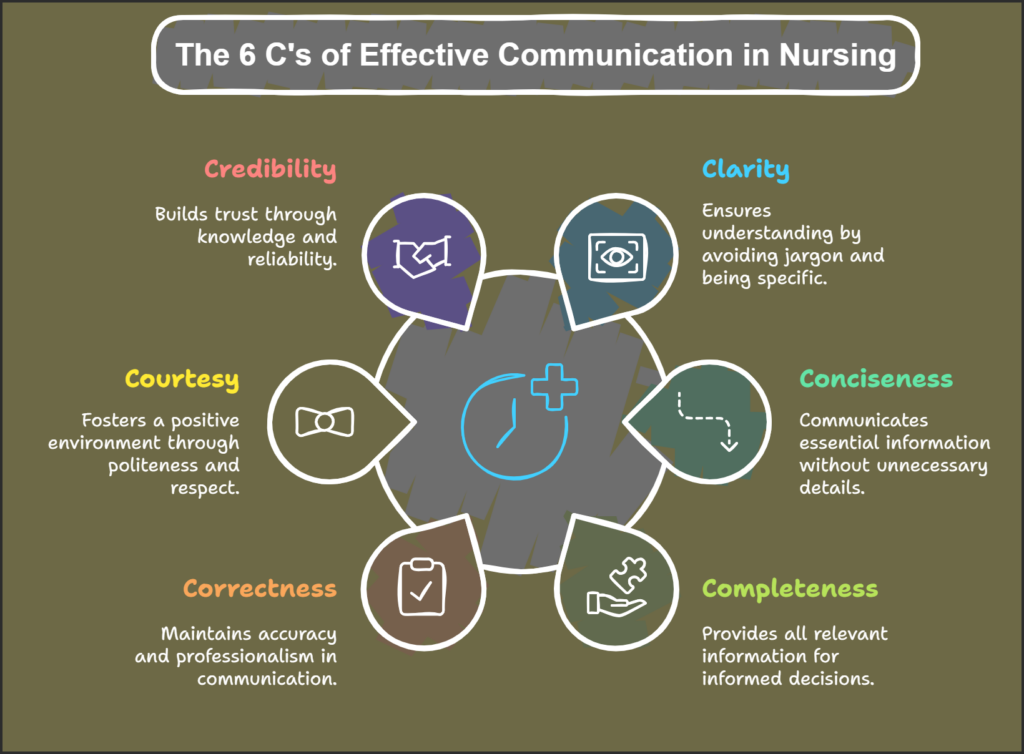
The 6 C's of Effective Communication in Nursing

Flawless communication is essential in nursing to build trust, establish rapport, and ensure quality patient care. The 6 C’s provide a framework for effective communication in nursing:

  1. Clear:
  • Avoid jargon: Use simple language that patients can understand.
  • Be specific: Provide clear and concise information.
  • Use active voice: This makes your messages more direct and engaging.
  1. Concise:
  • Get to the point: Avoid rambling or going off on tangents.
  • Use bullet points or numbered lists: This can help organise your thoughts and make your messages easier to understand.
  1. Complete:
  • Provide all relevant information: Ensure your messages are complete and include all necessary details.
  • Double-check for accuracy: Verify the accuracy of your information before communicating it to others.
  1. Correct:
  • Proofread your messages: Check for grammatical errors and typos.
  • Use proper terminology: Use the correct medical terms and abbreviations.
  1. Courteous:
  • Be polite and respectful: Use a friendly and respectful tone in your communications.
  • Listen attentively: Show that you are interested in what others say.
  1. Credible:
  • Be knowledgeable: Stay up-to-date on the latest nursing practices and research.Be trustworthy: Build trust with patients and colleagues by being honest and reliable.

By following these 6 C’s, nurses can improve their communication skills and provide better care to patients.

Common Communication Barriers in Nursing

Language barriers: 

Patients may not speak the same language as their healthcare providers, making it difficult to communicate.

Cultural barriers: 

Differences in cultural beliefs and values can make it challenging to understand and respond to patients’ needs.

Physical barriers: 

Noise, distractions, and physical discomfort can interfere with communication.

Psychological barriers: 

Patients who need mental healthcare may be anxious, stressed, or in pain, which affects their ability to communicate effectively. 

Cognitive barriers:

Patients with cognitive impairments, such as dementia, may have difficulty understanding and processing information.

Strategies for Overcoming Communication Barriers

Use clear and simple language:

You should avoid using medical jargon or technical terms that patients may not understand.

Use visual aids:

Diagrams, pictures, and other visual aids can help explain complex concepts.

Be patient and understanding: 

Give patients time to express themselves and avoid interrupting them.

Use interpreters or translators: 

If necessary, use interpreters or translators to help communicate with patients who do not speak the same language.

Be aware of cultural differences: 

Learn about different cultures and customs, and be respectful of patients’ beliefs and values.

Create a comfortable and welcoming environment: 

Minimise distractions and ensure patients feel safe and comfortable.

Use active listening: 

Pay attention to what patients are saying, ask clarifying questions, and show you are interested in their concerns.

Build trust: 

Establish trust with patients by being honest, reliable, and empathetic.

Seek help: 

If you are having difficulty communicating with a patient, don’t hesitate to ask for help from a supervisor or another healthcare professional.

By understanding and addressing these barriers to effective communication in nursing, nurses can improve their communication skills and provide better care. 

Interactive Quiz: How Effective Are Your Nursing Communication Skills?

To assess your current communication skills, take a short quiz:

1. When communicating with a patient, do you actively listen without interrupting?

     a) Always

     b) Sometimes

     c) Rarely

2. Do you ensure that the patient understands the information you give them?

     a) Yes, always

     b) Occasionally

     c) No, not always

3. Do you find yourself making eye contact and showing empathy when speaking with patients?

      a) Yes, always

      b) Sometimes

      c) Rarely

If you answered mostly “a,” you’re on the right track! If you answered “b” or “c,” consider implementing some of the strategies mentioned above to improve your communication skills.

Final Words

Effective communication in nursing is not just a skill—it’s a vital part of patient care. By developing and honing communication skills, nurses can improve patient outcomes, build stronger relationships, and enhance the overall healthcare experience. Nurses should be aware of potential barriers to communication and take proactive steps to overcome them. Remember, communication is not just about speaking—it’s about understanding, empathising, and responding appropriately.

FAQs

Effective communication is essential in nursing because it promotes patient safety, improves the quality of care, reduces the risk of medical errors, and builds trust between nurses, patients, families, and other healthcare professionals.

Nurses should develop active listening, verbal and non-verbal communication, empathy, critical thinking, teamwork, conflict resolution, cultural awareness, and accurate documentation skills to provide safe and compassionate patient care.

Clear communication helps nurses understand patients’ needs, explain treatment plans, encourage patient participation, and ensure accurate information is shared among the healthcare team, leading to better health outcomes and higher patient satisfaction.

Common barriers include language differences, heavy workloads, time constraints, cultural differences, emotional stress, hearing or speech impairments, and misunderstandings between healthcare professionals and patients.

Nurses can improve by practising active listening, seeking feedback, attending communication training, using clear and simple language, maintaining professionalism, and continually reflecting on their interactions with patients and colleagues.

Effective teamwork ensures accurate information sharing, coordinated patient care, faster decision-making, and reduced medical errors. Good communication among healthcare professionals contributes to a safer and more efficient clinical environment.

Good communication allows nurses to understand each patient’s preferences, concerns, and goals. It encourages shared decision-making, respects individual needs, and helps patients feel involved in their own care and treatment.

Yes. Strong communication skills improve leadership potential, teamwork, patient relationships, and professional credibility. These qualities can open opportunities for senior nursing roles, education, management, and specialised healthcare positions.

Effective communication helps nurses remain calm, manage conflicts professionally, deliver sensitive information with empathy, and support patients and families during challenging circumstances. It also promotes trust and reduces anxiety in stressful healthcare environments.

top
Select your currency
GBP Pound sterling